Tuesday, July 26, 2005

Discipline in Catholic High Schools, part II


(Practical Considerations for Principals Regarding Expulsions)

In my previous post, I argued that Catholic schools must view discipline differently than their public or private school counterparts. Namely, whereas secular schools might see school disciplinarians as judges who hand out "punishments to fit the crime" independent of the “criminal”, I argued that Catholic school disciplinarians are ministers of Christ who must use their creative abilities to design consequences for a particular child that helps him grow to be the person God wants him to be. Whereas "retributive justice" tends to be the aim of discipline in secular institutions, then, conversion must be the goal of Catholic school discipline. Whatever works to achieve this conversion, Catholic schools must be willing to try, even if it means, at times, “harming” the institution’s image for holding onto a kid longer than the local private school down the street might.

I believe this is a fundamental principle for a school that takes parables like the lost sheep seriously. Still, one might object on pragmatic grounds. One teacher on our faculty put it this way: “I understand going after the 100th sheep", he said, “but if you go after it, leaving the flock behind, what happens when you return and only find 85 sheep left? “

Great question! Faced with the decision to expel or not to expel a child, I have often wondered how Jesus would reply. I suspect the Jesus of the gospels would say: “You seek out the lost. Trust that I will shepherd the 99”.

Still, it raises the point: where do we draw the line for kids who are consistently disruptive, compromising the school’s ability to minister to other kids? Is there NEVER an occasion where the shepherd must let the 100th sheep go?

Yes, there are such times. I believe they boil down to two general circumstances:

a) When the child is a threat to the health and safety of other students. For example, we immediately expel students involved in the selling of drugs to other students. Regardless of our desire to help these children, we have a duty to protect the safety of others. In my mind, these decisions are most often made on the basis of a single incident, whether or not the child has a disciplinary record. I once expelled a National Honors Society student for lighting the boys’ bathroom trash can on fire, something I believe he thought was a playful prank. One stupid act is enough to jeopardize the safety of all. These expulsions are usually difficult for the parents (and principal!) since no one "sees it coming". Still, there are non-negotiables, and the safety of the other students over-rides everything.

b) When it becomes apparent that by “holding on” to a child, using as many creative punishments as we can for a time, that we are now becoming “enablers” of that child’s illicit behavior.

Like the wife of an alcoholic husband who must kick her husband out of the home to help him get well, sometimes the most loving thing we can do is insist a child leaves in hope that he will take responsibility for himself.

Typically, this second circumstance for expulsion comes at the end of a long series of events in which the student has been given series after series of punishments and the parents and principal have met many times before. What I usually do when I begin to think the school is now playing an enabling role is to set up a “1-2-3 strikes you’re out” interim step, in which I tell the child, with his parents present, that the next incident will result in an automatic 1 day suspension, that the second incident will be an automatic 2 day suspension, and the third strike will be “you’re out”. I do this because I want to put the student in the driver’s seat, which will help him or her take more ownership of the expulsion, if it comes to that (and not insignificantly, will help the parents handle the expulsion better, too).

The truth is that in over 50% of the cases, depending on how late in the year we set this arrangement up, the child will end up leaving before the year is over, but usually the expulsions go more smoothly because everyone saw it coming. I had two parents this year, upon learning their child had “struck out”, thank me for trying so hard to work with their child. While that’s nice, what’s even more important is the parents aren’t at home blaming the school for the expulsion, which means the expulsion has a far greater chance of being a significant moment for conversion in the child’s life.

If we handle expulsions in this second way, we are consistent with our mission to put the child first. We are not expelling a kid because he makes the school “look bad” or that he “annoys teachers” or even that he embarrasses us. We’re not expelling him for the sake of the school. If we do expel him for those reasons, we cannot avoid the damning criticism of one mother who told me, when I asked her to withdraw her child, “You’re just getting rid of the unwanted child, and I thought your Church was AGAINST abortion”.

That's not a bad test for us as we weigh whether or not we should expel a child from our school. Is it, in fact, an "abortion"? Or staying with the mother’s metaphor, is the expulsion more properly labelled a "miscarriage"? It seems to me that with the exception of a child who is threat to the safety of other students (as noted), we cannot ask a family to withdraw their child unless we can honestly conclude it's a "miscarriage".

Let me end my reflections with a re-telling of the parable of the rich young man from Luke 18:

And it so happened that a veteran teacher approached Jesus.

“Good Rabbi”, he asked, “what must I do to become a more professional teacher?”

“Why do you call me good? Jesus responded. “No one is good but God alone. You know the rules. Design interesting lessons. Create good assessments, grade them carefully and turn them back on time. Be excellent in your teaching and you can expect excellence in return.”

The veteran teacher beamed: “I have done these things since my first day of teaching”.

Jesus, eyeing him, said; “There is one thing further you must do. Take the student who is most troublesome to you, and treat him as your only son.”

At this, the teacher walked away sad, for he was a busy man.


In my third and final post on Catholic school discipline, I will look at day to day disciplinary incidents and how we handle them in our school.

Monday, July 25, 2005

Discipline in Catholic High Schools, part I


(Philosophical Considerations for Principals)

If you ask parents what they want in a Catholic school, a “well disciplined environment” ranks right up there with a strong academic program and a community of faith for their children.

But what marks a well disciplined Catholic school? Is a good Catholic school different from its public school counterparts only in that it is a MORE disciplined environment, or should we mean something different altogether?

I argue that Catholic schools, if they are going to be true to their mission and founder, must regard discipline differently. Whereas public and private schools might describe a good disciplinarian as one who "keeps order" and "acts fairly", I suggest in a Catholic school, a good disciplinarian is one who creates conditions that encourage each child grow into the person God wants him or her to be and makes decisions accordingly.

If that strikes you as a mushy distinction, let me share a story about myself as a young principal that may clarify the point. When I was a teacher at our school before becoming its principal, I was critical of the previous principal, who had been in place 17 years. He never seemed to handle the kids in the same way. Worse, I noticed that even in the case where two kids did the same thing wrong, his punishment varied. Since he was a mentor to me, I asked him about this, accusing him of being seemingly “unfair”. He asked me what I meant. “Well”, I remember saying, “it’s simply wrong that different kids get a different punishment for doing the same thing wrong. Your discipline is idiosyncratic and that’s wrong. Punishment should be based on the action, not the person.” “Well if that’s what you mean by unfair”, I remember him saying, “then I plead guilty as charged”. I was puzzled by his response but made up my mind to do things differently when I took over.

The public schools around town at that time had adopted a “uniform code of conduct” that impressed me. They categorized routine disciplinary issues common to high school life as level one, two or three depending on the severity of the act, and with each level came a set of proscribed punishments which escalated based on frequency of offense. In that way, no matter the kid, everyone knew up front what would happen and this consequence would be evenly applied across the school system.

So the summer I became principal, I wrote out an unofficial “uniform code of conduct” as a guideline for myself. For two months that first fall, I labored to be absolutely consistent in applying these consequences to the many students and incidences I handled. Somewhere around Thanksgiving, I was faced with a situation that demanded (by my code) a three-day out of school suspension for a troubled sophomore boy, a consequence I was reasonably sure would cause his family to withdraw him from our school. If he left for the local, massive public high school in town, I didn’t like his chances. So I balked at my code, convinced that it wasn’t the right way to handle that kid. He was a good kid. He was “save-able”. Instead, I made him come out to the school on consecutive Saturdays and an in-service day (something I now call a “reverse suspension”) to do “gardening” (i.e. weeding the school flower beds) , scrape gum from under cafeteria tables, pick up trash and whatever else I could dream up to make the point. It worked. Over the course of his sophomore year, his behavior improved and he later graduated. I tore up my unofficial code of conduct by Christmas of my first semester and have handled disciplined idiosyncratically ever since.

As I am apt to do, I wrote a parable that reflected this new self-understanding:

A new principal, wishing to make a good impression, said “I will treat all students the same, for fairness sake”.

Shortly thereafter, two young men were sent to him for a disciplinary incident. The principal said “Policy dictates a three day out of school suspension for both of you.”

The first young man, working closely with his parents, came back from his suspension with resolve to do better.

The second young man dropped out.

And everyone agreed the principal acted fairly.


My role as a disciplinarian at our school is NOT to be a judge who dispassionately hands out punishment to fit the crime, as I once argued. Rather, my role is to be a minister, willing to do anything that helps a child become what God wants him or her to be. Don’t take that wrongly-- I don’t mean that a school should substitute discipline for touchy feely nonsense. There should be consequences for every action, and in the case of severe actions, severe consequences. What I do mean is that we in Catholic schools shouldn’t rely on scripted consequences that ultimately prize “fairness” more than what is in the best interest of the child we serve. Secular schools understand discipline as a means to create order. We are first and foremost interested in the child’s conversion. “Fairness” and even “order” misses the point by prioritizing the institution’s needs over the child’s. Our "punishment" shouldn't fit "the crime" but "the person". The reason the parable of the lost sheep is so challenging to us is that it’s counter-intuitive: unlike the famous phrase from Star Trek, the “needs of the many" should NOT "outweigh the needs of the few” in Catholic institutions.

Instead, I am charged to use all my creative thinking to design consequences that work for THIS child, but may not work for others. That’s what I mean when I say discipline in Catholic schools should be aimed at “creating a set of conditions which encourages each child to become the kind of person God wants him or her to be” and how I see that Catholic schools are different than their public or private school counter-parts.

Catholic school principals, then, should not create disciplinary policies that are so specific that their hands are tied when confronted with a unique student and situation. For this reason, our student handbook has only this to say about discipline: “Students who violate the rules and procedures of this handbook or who act in a way contrary to our mission as a Catholic school will face disciplinary consequences as determined by the teachers or principal, depending.”

“OK, OK”, you might be thinking. “That all sounds good in theory, but how can a principal, given the demands on his or her time, possibly run a school such that EVERY child and EVERY situation is handled differently?” You may be also thinking, “Is he implying that Catholic schools should never expel a kid?”

Those are good, practical questions, and I will address them in my next article.

Friday, July 08, 2005

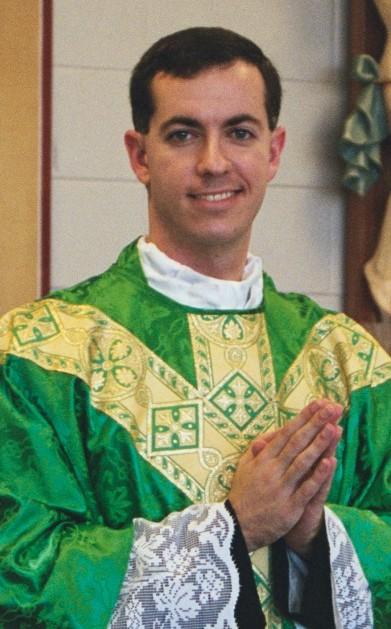
Rest in Peace, Father Labadie

One Friday afternoon not so long ago, I was observing classes and came to Fr. Labadie’s sophomore Catholic Doctrine class. Suffice it to say that a doctrine class doesn’t normally make a 15 year olds’ top ten list of places they’d like to be on a Friday afternoon, and to make it worse, they were apparently reviewing for a test. Fr. Labadie was pulling out all the stops to keep their attention. He was standing on top of his desk, peering over the edge, crying out in mock pain: “Rebecca, if you don’t know the answer to this question, I’ve failed as a teacher and I’m going to jump”. Everyone watched with anticipation and amusement, hoping Rebecca would get it wrong.

The Fr. Labadie I will remember was this teacher—energetic and creative. Folks often ask me what makes a good teacher, and I say they need to have two qualities: they must know their subject matter very well, and they must have that hard to define “with-it-ness” – a certain quick-wittedness and quirkiness—that all good teachers seem to possess. Fr. Labadie had both.

He combined them with a real zeal to serve the Lord and his Church. He attended ball games. He could talk sports with the boys and tease with the girls. He heard confessions. He said Mass and gave thoughtful, passionate homilies. A black woman, hearing him preach one day, told me “he had the anointing”. Students loved him.

Very early morning, June 28, 2005 he took his own life.

What a loss for our school! What a loss for our Church! What a waste.

I suppose the “why” question is inevitable at moments like these, but like Job, we get no answers other than God’s ways are not our own. Still, it’s easy to second guess: earlier that day, he had called me and talked on the phone about teaching in the fall: Yes, I was hoping he could be our chaplain, yes, I’d like him to teach a couple of classes. Yes, I hoped that he would be assigned as an associate in a local parish. “Idleness is not good for us men” I had joked. “We need to stay busy”. He laughed and agreed with me. All lights were “green” for this fall.

Well, not all the lights.

Here’s what I do know: Despite his talents and faith, Father Labadie was sick with depression. He had been sick for a long time. Like most men that I know (I could see myself doing the same thing), he tried to deny his sickness was mental. If he ate differently, he would be OK. If he got more sleep and exercise, things would work out. If he could get the right prescription, perhaps that would work. But it was slipping away. He missed classes, was late for appointments and was increasingly unable to do the most ordinary of things. By January, it was apparent that something had to change. He couldn’t remain a teacher without getting well. The archdiocese sent him away to get well.

Fast forward four months, when Father Labadie came to our graduation in late May. He wanted to be with the first class he taught at Catholic. He looked so much better. He had gained back weight that he lost. He seemed more alert. He was happier. Yes, he said, he had been sick, but he was almost better--just a few more weeks in the program. He was eager to return to teaching. He missed the students and they missed him. After visiting with them, he went back to the program to finish the business of getting well.

Now, here at the end of June, he returned as part of his program’s “therapeutic week”. Visit your home town for a week, make arrangements for your support group, get things in place, and return back to the program for the final two weeks to discuss things and make final preparations to get on with living. That’s why he had called me about the fall. He was making the arrangements, eager to get on with living.

Until early that next morning.

One of the more helpful remarks that I’ve heard as I’ve mourned his loss with others is that battling depression is a lot like trying to balance in the midst of waves. Just about the time you get your balance, a large wave comes and knocks you off your feet. You didn’t see the wave coming.

That wave hit Father Labadie on Monday night. It wasn’t premeditated. It wasn’t planned. Everything in his life these last five months was about planning the opposite: to get himself well enough to be in the classroom again, standing on the edge of that desk and pulling out the stops to teach the faith to others. That was his love and his passion. He became a priest to bring others closer to the Lord. He did that here at Catholic in the short time he was with us.

If there were any doubt as to his effect, one need only have been in our high school since Tuesday. As word of his death spread in our student community, streams of students began visiting our chapel to pray for him and his family. There was a board outside our chapel, in which students were invited to write notes. One note struck me hard: "So here we are Father, doing as you taught us to do, coming to the Lord to pray when we're hurting inside."

Their prayers are an eloquent eulogy for a young priest who lived too short a life.

In the end, as to why, I have no answer--only the answer of our ancient faith:

“I believe in the communion of saints, the forgiveness of sins, the resurrection of the body, and life everlasting. Amen. “

Rest in peace, Father Labadie.


Faustin N. Weber