 Editor's note: These are my notes for orientation on August 7, 2006 for all teachers in our K-12 school.
What does it mean to be a Catholic educator? I believe at the heart of Catholic education are four underlying beliefs:
1. Our students are children of God—worthy of being educated, loved, listened to, cared for and (I think significantly) believed in.
There is tremendous cynicism about youth today. Recently, I was talking to a colleague who launched in on a tirade about the terrible state of “kids these days”.
But you know what? If there is any basis for the cynicism, it’s our generation’s fault, not the teenagers’. It’s not 18 year olds who are responsible for high rates of marital infidelity, lack of commitment, corporate greed, political scandal, or sexual deviancy.
IN fact, I believe that kids are naturally idealistic. But our society tells kids it’s impossible to lead a moral life, that it’s impossible to abstain from sex for example, and people who try to do so are either prudes or (worse) naïve, so practice sex safely. Television stations like MTV aren't created or produced by 18 year olds, but by 40-somethings—and there is something very sick about corrupting the natural idealism of youth in order to sell products for profit.
Catholic schools MUST be a powerful antidote to such cynicism--when kids enter our room each day, they should almost FEEL the hope and FAITH we have in them.
Especially, our most troubled students! They are likely our most troublesome students because they have been least well cared for, and as a result, the ones who are least convinced that they are worthy of being loved or believed in. So much of their acting out is a test of US, to see if we can confirm in our reactions what he despairs about himself: that he is not worthy of love, that he feels little hope for his future. We cannot give in to despair for these kids! We must be, rather, people of the resurrection in their lives.
A challenge for everyone in this room: I’m guessing by the end of the first day of school, each of you will know who the 2-3 kids are that will be most in need of our attention this year! I challenge you to look at these kids not as your biggest
burdens, but as the chance for your greatest
successes, an opportunity to make a life-long impact on these kids'lives.
There's a teacher on this faculty, who by about November had just about had it up to here with a certain boy who shall remain nameless. To be blunt, this boy was really acting like a horses’ rear end, and to make matters worse, I think she taught him for two classes/ day! But I remember her saying, deeply frustrated, almost in tears, “As much as I want to, I will NOT give in, I will NOT write him off. I will NOT become cynical about him. He WILL be better behaved eventually, and we WILL get along, but on my terms.” I remember being very edified by her toughness and attitude. I asked her, several months later, how things were going with him, and she said something like “Well, there is the occasional bad day, but we’re getting along pretty well now. He’s actually becoming a pleasant person, most of the time”. What made the difference? The teacher did--despite the boys' actions, she refused not to love him.
The real truth that we must never forget as Catholic educators is:
LOVE is redemptive. If we bring Christ’s love to our students each day, even our most annoying, troubled student, Christ’s love can redeem them—and redeem us in the process.
“Eye has not seen, nor ear heard, nor has it entered into the heart of man, what things God has prepared for those who love him.” (I Corinthians 2:9)
2.
Education is a moral endeavor, undertaken by a community of adults—I’ve spent lots of time on the web, recently, looking at other school web sites. Schools have a tendency to measure success in terms of test scores, college scholarships, graduation rates, A.P. test performances. And yes, we do some of that too. We brag when our kids score 800’s on SAT tests, as a senior did on 2 out of 3 of the subtests, or when 4 of Mr. Petrof’s A.P. American History students score perfect 5’s on the A.P. exam. Those are good things, and we’re right to be proud of them.
But let these stats not obscure the true measure of our success—the Ockham’s razor by which our school should be judged a success or a failure is simply this: do we help children become the people God wants them to be? Our ultimate aim: cooperate with God’s grace to help them become these people. In so doing, we know they will be happy.
“Glory of God is man fully alive” St. Irenaeus of Lyons
Are our kids “fully alive” when they leave us after 13 years of K-12 schooling?
This isn’t just a responsibility of the theology department, but of the entire community of adults: teachers, coaches, office staff, and parents.
(Jon Moline, “Classical Ideas about Moral Education”, in Character Policy: An Emerging Issue) “As Aristotle taught, people do not naturally of spontaneously grow up to be morally excellent or practically wise. They become so, if at all, only as the result of a lifelong person and community (emphasis mine) effort”
So yes, it takes a village.
What a profound effect Tim Trokey or a George Forhan or a Jill Clark can have on the attitudes our athletes have about themselves, about being people of character, and about their faith in God. None of these 3 are Catholic, but each plays a profound role in the mission of this school. And when adults paint side by side with students in the gym as they did this summer, or when teachers go out of their way to correct a student, gently, about some behavior a kid is doing wrong—they all take part in this fundamental mission to help kids become what God wants them to be.
3.Parents are the primary educators. Now we have to be careful: I’ve heard this line used by teachers in this room as an excuse to get out of work:
A kid hasn’t done his homework in 4 days. “Oh well, the parents are the primary educators…if they’re not going to do their job, how do they expect me to do mine”…. And then, you see, the teacher absolves himself from that kids’ failure. “Not my fault”.
In Catholic educational philosophy, parents ARE the primary educators, and we ASSIST parents in that role. In other words, we’re a team, and I think that means three very practical things for us:
--first, we trust parents to make the right decisions for their kids (Mardi Gras, parents write a letter, child will be out for 2 days, husband off work—do we give them permission to go?)
--second, we try and foster good communication with parents—in both directions. On Back to School Night, you should give your school email address and voice mail number at school to every parent. Maybe even have a business card, and invite them to call you whenever they have concerns. You should similarly CALL THEM, not just for concerns, but for praise. Open lines of communication. Especially in the case of a kid doing poorly, we should do much more than take the contractual, minimalist position “Well, I informed you through the report cards and you never contacted me”. That’s simply unacceptable.
--third, I think being on a team (and I think every married person in this room understands this) means forgiving and moving on. Parents aren’t going to always respond as they should. We have to forgive them for that, insist on a professional working relationship, not let it affect us the next time we should communicate with that person, and move on. We must remember that when we’re talking to parents about their child, we are treading in an area where parents are MOST vulnerable, and often, they don’t respond as they should. Let us tell the truth with love, forgive if responded to inappropriately, and always remember to put the needs of the child first.
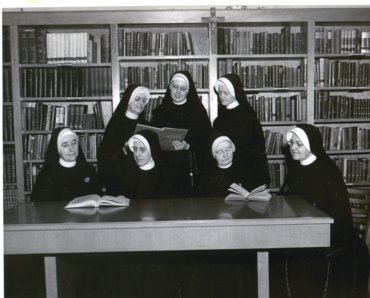
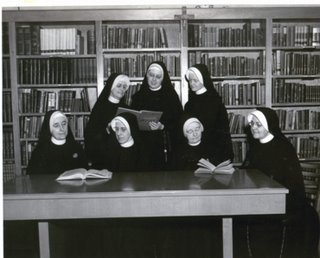
4. We make no compromises, no excuses.I’m not sure that this is really Catholic educational philosophy so much as the legacy from the Sisters of Loretto who founded our school, if not all the sisters who began our schools around the nation.
Catholic was founded in the 1870’s, by the Loretto sisters, a hearty band of women from KY. They moved into Montgomery, Al, the“buckle on the bible belt”, into the land of the KKK and in the middle of a deep suspicion and misunderstanding of Catholics to start a Catholic school for girls.
They purchased an antebellum home, Gerald Mansion, with the intent to live upstairs and teach downstairs) right across from St. Peter’s Church downtown, where now sits the courthouse and jail (I’ll let you create the joke here!)
Just prior to opening the school, there was a yellow fever epidemic, and the school’s opening was delayed for several months—instead of a school, the mansion became a hospital, and the Loretto sisters earned instant respect for their care of the sick of the city.
They had very little money. But they had grit and determination to make that school work. These were well educated women, but they VERY poorly paid, no “benefits”, and they worked, by today’s standards, in deplorable working conditions.
Sr. Martha Belke, the last Loretto sister to teach here, who taught Chem and IPS for 35 years (Our Belke building is named after her), told me her first class (at the age of 19, before she had graduated from college) had 51 students in it: 25 first graders and 26 second graders.
(People have wondered why the sisters are “mean”!)
But those kids were WELL educated. The sisters didn’t complain about their working conditions, their salaries, how underappreciated they were. No compromises, no excuses!
This is our legacy here. The mission of this school comes before all else—before any of our needs, before any convenience—more important than winning games, test scores, college acceptance rates. We will do whatever it takes for a student to be successful, and we will NOT give in to the temptation to write some kids off because the majority is doing fine.
All students in our classroom will learn. And if they aren’t learning, we will intervene, first as teachers, then as the school itself, to demand they will learn. The mission of the school is first.
Parallel this to “defiance” of teacher. Just as everything stops until the defiance is challenged, so too if our mission is being challenged, everything else stops until it’s addressed.
We are not rightful heirs to the legacy of the Sisters of Loretto unless we embrace this challenge directly.
In summary then, as Catholic school teachers, we believe that
All students are Children of God;
That education is a Moral Endeavor undertaken by the Whole Community;
That we are Team-mates with parents;
That the Mission comes first, no excuses, no compromises.