Tuesday, January 03, 2023

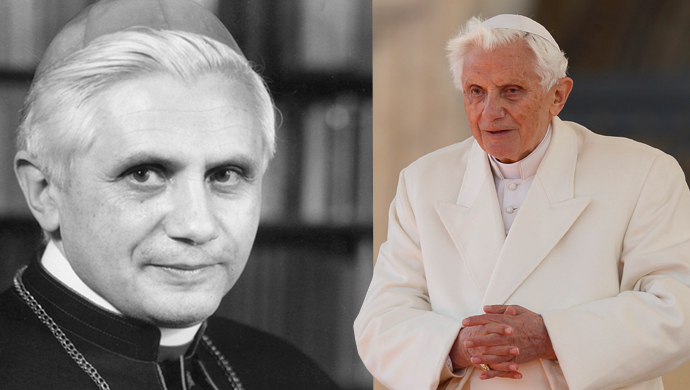
Rest in Peace, Pope Benedict (1927-2022)

Pope Benedict passed away at the age of 95, on the last day of 2022. His funeral will be this Thursday, January 5. He was pope from April of 2005 to February 2013, the successor to (now saint) Pope John Paul II and predecessor of Pope Francis. Though not as personally “charismatic” as JPII, nor perceived to have the “pastoral warmth” of Francis, he was a man of great faith and intellect, having published over 65 books on matters of theology and spirituality, many as a professor of theology before being elected pope. He was one of the pivotal players of Vatican II in the 1960’s, both during the Council and in the decades-long discussions that followed.  As pope he wrote three important encyclicals, four apostolic exhortations and gave thousands of homilies and talks, many of which are available on line. 


It would be ludicrous to try and summarize the immenseness of his thinking in an article, and I am not expert enough to have the hubris to even try. At the same time, it would be a shame not to at least get a “taste” of his thinking this week, as we prepare for his funeral on Thursday. The best way to do that, I think, is to read some of what he said himself! 


Here, then, are a few curated quotes that speak powerfully to me. He gave his whole heart and his prodigious mind to the Lord, and I believe his thinking will anchor Church thinking for many generations to come. 


Regarding theology:


"We have to ask questions. Those who do not ask do not get a reply. But I would add that for theology, in addition to the courage to ask, we also need the humility to listen to the answers that the Christian faith gives us; the humility to perceive in these answers their reasonableness and thus to make them newly accessible to our time and to ourselves."
—Speech, March 21, 2007

On relativism:

"Having a clear faith based on the Creed of the church is often labeled as fundamentalism. Whereas relativism, that is, letting oneself be 'tossed here and there, carried about by every wind of doctrine,' seems the only attitude that can cope with modern times. We are building a dictatorship of relativism that does not recognize anything as definitive and whose ultimate goal consists solely of one's own ego and desires."
—Homily, April 18, 2005

On freedom:

"The person who abandons himself totally in God's hands does not become God's puppet, a boring 'yes man'; he does not lose his freedom. Only the person who entrusts himself totally to God finds true freedom, the great, creative immensity of the freedom of good."
—Homily, Dec. 8, 2
005

On religious freedom:

"It is inconceivable, then, that believers should have to suppress a part of themselves — their faith — in order to be active citizens. It should never be necessary to deny God in order to enjoy one's rights. ... The full guarantee of religious liberty cannot be limited to the free exercise of worship but has to give due consideration to the public dimension of religion, and hence to the possibility of believers playing their part in building the social order."
—Speech at the United Nations, April 18, 2008

On the Sacrament of Confession:

"It is very helpful to confess with a certain regularity. It is true: our sins are always the same, but we clean our homes, our rooms, at least once a week, even if the dirt is always the same, in order to live in cleanliness, in order to start again. Otherwise, the dirt might not be seen, but it builds up. Something similar can be said about the soul."
—Response to children's questions, Oct. 15, 2005

On abortion: 

"The fundamental human right, the presupposition of every other right, is the right to life itself. This is true of life from the moment of conception until its natural end. Abortion, consequently, cannot be a human right -– it is the very opposite."
—Speech in Austria, Sept. 7, 2007

On setting goals: 

“The world offers you comfort. But you were not made for comfort. You were made for greatness.” (unknown)

On becoming weary:

“There are times when the burden of need and our own limitations might tempt us to become discouraged. But precisely then we are helped by the knowledge that, in the end, we are only instruments in the Lord's hands; and this knowledge frees us from the presumption of thinking that we alone are personally responsible for building a better world. In all humility we will do what we can, and in all humility we will entrust the rest to the Lord. It is God who governs the world, not we. We offer him our service only to the extent that we can, and for as long as he grants us the strength. To do all we can with what strength we have, however, is the task which keeps the good servant of Jesus Christ always at work: “The love of Christ urges us on” (2 Cor 5:14).” --God is Love: Deus Caritas Est

Saturday, December 03, 2022

Christmas Without Edges


When I was a teacher,  I asked some form of this question to my students each year before Christmas: 

“In my neighborhood of 200 or so homes, there are 5-6 homes with Christian decorations out front, and well over 100 homes with lights, Santa’s, reindeer and other inflatables. Roughly 80% of all Americans would say they are Christian.  Why, then, do you think we’re so reluctant to profess that faith at Christmas time? “

“People don’t want to be preachy,” they tell me.  “Yeah, they don’t want to come off as better than their neighbors,” another says.  “I think it creates awkwardness,” says another, “better to play it safe.” 

I’m pretty sure my students are correct. We don’t want to imply that we’re more religious than our neighbors, so we opt for the lowest common denominator, choosing instead to celebrate fictional children’s stories:  large blowups of Frosty the Snowman, or Santa riding in his sleigh, or Rudolph grazing with other reindeer. 

I’m not a killjoy! I’ve raised four children, and when they were young, part of our Christmas tradition was to drive around neighborhoods, oohing and aahing at the lights, “rating” who put on the best “show.” 

But at the same time, we're in danger of losing something precious, aren't we? By not celebrating the Christian story explicitly, by reducing our Christmas decorations to those which give least offense, I fear we’re losing the sharp edges of Christmas that make it such a compelling story-- full of human emotion, irony and beauty. And if we rub down these sharp edges, what’s left?  

Consider what the gospels tell us. Mary and Joseph are compelled to travel from Nazareth to Bethlehem for reasons of the census, with Mary soon to give birth. That’s a distance of 90 miles, by donkey, which would likely take three, maybe four days. We don’t know Mary’s exact age—Scripture says a “young virgin”—but at that time girls were often married  just after menstruation, so scholars believe Mary was likely on the younger side of the teenage years. In her ninth month, she would have been terribly uncomfortable on that trip, terrified at the prospect of her first birth like all mothers, and undoubtedly cranky. If Joseph was the typical husband of his day, he'd have been about 19-20 years old (not the older man that some Christian artists depict). He would also be weary from the trip, worried for his wife, uncertain of himself, frantic at not finding a suitable place for the birth. He must have felt like a lousy provider. 

And what about that stable? Perhaps because of the influence of Christmas carols like “Silent Night,” we tend to imagine the stable animals as quiet, docile things, staring lovingly at the newborn, glow in the dark, Christ-child. But surely it was a horrible racket of nay-ing horses, baa-ing sheep and bleating goats! New mothers and newborns need sleep, so this was a terrible state of affairs! Mary must have been utterly exhausted. Our carols talk about the “sweet smelling hay.”  Well, there was certainly a smell, but it would have been from animal manure, the stench of which can be overwhelming.

Forgetting all this, we miss the great irony of Christmas: the angels proclaiming to the shepherds, “Glory to God in the Highest!”  and “A savior has been born, who is Christ, the Lord!” Might they have imagined a great king, born of a royal household? Instead they find a much lowlier state of affairs: the newborn infant of a peasant carpenter and mother, lying in a feeding trough. Did the manger still have remnants of the slop fed to the animals? If not, I’m sure it retained the odor. 

And what of the warning that Joseph and Mary had to smuggle Jesus out of Bethlehem to Egypt, to avoid the murderous intent of Herod? That reads more like a spy novel than a sweet children’s tale.

We do this often to the gospels, which have become so familiar to us that we miss the human element—the "hooks" that grab us. We’ve reduced the cross, for example, to jewelry, forgetting the brutality of ancient crucifixions. When I speak to students about crucifixion, I point out that Rome maximized its deterrent effect, first by forcing the crucified person to carry the upper beam through public streets, then by humiliating him by stripping him naked, and then by prolonging his death on the cross for 2, 3 or 4 days, expertly avoiding the major arteries when hammering in the nails. The crucified person would eventually die of suffocation, too weak to push up with his legs to regain his breath. "Death by crucifixion was so excruciatingly painful," I remind them, "that breaking the legs of the crucified with a sledge hammer to hasten suffocation was considered an act of mercy."

One student, after listening to tall this, asked “Mr. Weber, all this Christian fascination with Jesus’ death, isn’t it, well, a little morbid? If Jesus had come today, would Christians 2,000 years from now be wearing little electric chairs or syringes around their necks?”  “Yes! Exactly so!” I said, delighted. Such was the cross regarded in its day. But morbid? No. In fact the opposite: the cross becomes the instrument for our salvation. 

And so, my prayer for all of us this Christmas is that we are “snagged” once again by the jagged edges of the gospel, so that in our celebration of Christmas,  we're brought back to the foot of the crib, filled with awe and gratitude.

He is Emmanuel, "God with us!" Come, let us worship him! 

Merry Christmas. 


Tuesday, November 29, 2022

Waiting!


We are in the middle of Advent. The word “advent” means “coming,” and of course, it’s a reference to the coming of Christ at Christmas. So over the next four weeks, we await the coming of Christ.

We’re not very good at waiting. We want everything immediately! Think about it: The fast food industry has exploded in the last thirty years because people want their food quickly, and don’t have the time or patience to cook it at home. We have fast food drive-through lines because it’s "way too much work" to park the car, walk several feet and stand in line to order. And even with drive-through lines, if you’re like me, you become impatient if the line is not moving quickly enough! Now we have Dash and UberEats, which delivers food right to our door. 

In this digital world of ours,  information can be shared instantly, which is fantastic on one level, but dangerous on another, as it’s too easy to text someone when we’re angry at him or her,  before we’ve given ourselves a chance to cool down. We have overnight printing, overnight mailing, instant food, microwave ovens—all things that allow us to get what we want now, without waiting. If we want something and can’t afford it, no need to wait and save for it—we have credit cards! The average American adult has an alarming nine open credit card accounts and carries an average debt on those cards of $8,000.  The T-Mobile song says "I want it all. I want it all. I want it all, and I want it NOW!"

So it’s hard for us to wait for Christmas—we hardly wait for anything else. Stores are already in the full court press, pushing us to get all our Christmas shopping done. I was in a local store in October, before Halloween, and they were already playing Christmas carols.  So in Church we’re singing “O Come O Come Emmanuel” but everywhere we go we’re hearing “Joy to the World, the Lord has Come. “

I want to suggest two simple things we can all do that may help us step back from the helter-skelter world of the instant, the “now” that we all live in—two things that might help us better focus on the event we will celebrate on December 25 and thus help us have a better Advent.

The first is this: Nothing helps us tune into the true “reason for the season” better than helping other people.  There’s not a better time to do it. The Christmas season is a very lonely time for many elderly, as they miss their spouses who have died, or perhaps their children who don’t visit them enough.  Do you have an elderly grandparent or other relative? Visit them--just you. Ask your mom and Dad if they can drop you off and pick you up. It'll make a world of difference to them. What about another older relative? An aunt? A great aunt? What about an elderly neighbor? You showing an interest in them will have a huge impact.   Be there for them! 

You know, it’s pretty common that we, too, can get depressed or start feeling blue at this time of year, and our tendency is to say to ourselves, “I need some time for myself”, some “me time” but that’s exactly backwards. The best way to get us out of our funk is to focus on the needs of others, to make others happy. This is a great time of year to do it.

My second suggestion to get us ready for Christmas, to help us more fully appreciate this Advent season, is to spend about 10 minutes/day in prayer, asking God to lead you, bringing your worries before him, seeking him for guidance on decisions you must make about friends and personal issues. God accepts all styles of prayer!  We just need to turn off our cell phones, thank God for all he's done for us, and then bring our worries and prayers to him.  We don’t lean enough on God—but unless we lean, we cannot feel him pushing back, holding us up. And so we put all this pressure on ourselves to make good grades, go to the right high school, worrying about what people think about us, instead of sharing those worries with God and asking him to help us.

If we go outside of ourselves to help others, if we pray and lean on God during these next few weeks, I think we’ll find this Advent season, this time of waiting, will help prepare us more fully for the most important event in human history. 

May we use our time well.